Sunday, October 30, 2011

Remembering loved ones with a bouquet locket


What a wonderful and significant way to remember loved ones who have passed on your wedding day!  

In a recent wedding I attended, the bride remembered her grandmother with a beautiful glass locket tied in her bouquet, keeping her memory close on her special day. The wedding program mentioned the locket, so guests could also share in this touching significant detail. 

The locket can be hand tied with a ribbon or chain (or even pinned) on the front of the bouquet. Or it can be privately and more subtly hidden under the petals and facing the bride. However its done, its a sweet way to honor important people in your life that cannot be there with you on such an important event. Then afterwards, the locket becomes a lovely keepsake from your wedding.

Simply luxurious....


Take a soothing soak in my hand blended spa bath tea! When you are relaxing in the comfort of a warm tub of water your skin can soak in the nutrients it needs from natural herbs and oatmeal in this bath tea. This mixture also provides skin moisturizing benefits and general emotional renewal and stress relief.

INGREDIANTS:

Oatmeal - helps smooth and comfort itchy, scratchy, and dry skin...will give your skin a silky feel.

Lavender Buds - Brings calm to the senses; useful for relief of stress, tension, and headaches.

Chamomile Flowers - relaxes tired, achy muscles and feet, and softens the skin.

Rose Petals - offers a soothing property to the nerves and emotional state of mind.

Fill up my all natural cotton muslin draw string bags for a convenient and easy to clean up soak in the tub!

Saturday, October 29, 2011

Great recipe for Natural "Green" Lavender Household Cleaner


Fill a jar about one-quarter full of blue/grey lavender buds and then fill the rest of the jar with white vinegar. Place the lid on the jar and leave in a warm spot (a windowsill is a good place) for about two weeks. Shake daily. Strain out the lavender buds (you can put these in the compost pile). Use your new cleaner to clean kitchen counters (repels and also kills ants), windows, etc. It is also a good spray into the air around the grill to repel flies, but be careful not to get downwind of it because the vinegar may sting your eyes.

Saturday, July 11, 2009

New Locket Design....


I am loving my new design and they are selling like crazy! I am making small glass cabochons (usually millefiori flowers) and adding them to pretty glass (magnetic closure) lockets. They jingle around inside and the pieces are interchangeable. So much fun!

I will have new ones coming soon with custom monogrammed initial cabochons!!

Check them out at: http://glasshousejewelry.etsy.com or you can buy the blank lockets in my supply shop (to make whatever you wish) at: http://glasshousesupplies.etsy.com

Sunday, January 18, 2009

Pantone Fashion Color Report Spring 2009


I always find it interesting to keep an eye on the Pantene color report. It gives a glimpse at fashion trends to come...especially in terms of color. And I just adore color!

Here is what they are saying for spring 2009: A summary of the top Spring 2009 colors to be found in the report are:

The Blue Hues
Palace Blue — a favorite amongst designers which takes a navy undertone and makes it sparkle. A cross between a sky blue and strong navy. This is a color which works with almost any other, pink, yellow, lavender or green.
Lavender — the regal purple of fall has been adapted to a softer lighter lilac, feminine and romantic, and slightly mystical.
Rose Dust — a pale pinky blue, which is a welcome break from traditional neutrals. Almost a white-washed lavender, this is one of the coolest colors.
Slate Gray — a cool and calming nuanced neutral which provides a backdrop to any of Pantone’s 9 other colors and is a perfect pairing to lavender hues.

The Red Hues
Fuchsia Red –—Vibrant yet seductive, powerful and robust. Fresh and dazzling, fuchsia features heavily in nail polish and lipsticks too.
Salmon Rose — Mixing a soft salmon pink with the subtleness of oranges which is flattering to most complexions and gives a warm healthy glow.

The Green Hues
Vibrant Green — a mossy mid-green which is bright but not harsh
Dark Citron — a calm, almost olive color which blends perfectly with this season’s lemon tones.
Lucite Green — a clean, subtle, soft green which adds a slight shimmer

Yellow
Super Lemon — brings a fun, optimistic outlook to the Palette,” states the Pantone Spring 2009 report. “Its luminosity is determined to evoke a smile and attract the roving consumer’s eyes.”

Monday, December 1, 2008

Wonderful Customers....


I love all of my customers... Though some really catch my eye with their talent and creativity. urbaneden has taken my french lavender and made these gorgeous eye pillows out of upcycled vintage silk kimonos. What a luxuriously elegant way to relax!

Saturday, November 8, 2008

Glass House Supplies

I have opened another Etsy shop to sell a variety of items. I have listed my fused glass cabochons and other supplies. In addition, I have been selling wonderful imported french lavender from Provence (a very big seller!), botanical bath teas, dried rose petals, sachets, and my very own home made yummy soaps!

Come check it out: http://glasshousesupplies.etsy.com

Thursday, March 20, 2008

Buttons....


I recently filled a custom order for handmade fused dichroic glass buttons. I was so happy with the way they turned out that I am now making them left and right. The uses for them are endless! They add such interest and excitement to knits, crochet, clothing, accessories, etc. They are truly a focal piece that draws attention.

I truly enjoy my custom orders because I get to work closely with my customer to realize their vision. It often causes me to step outside my usual zone of comfort and the end results can be very exciting!

Tuesday, December 18, 2007

The Rachael Ray Show ...

...featured one of my pieces on Etsy.com today!! I am so excited and flattered! I don't think my feet have touched the ground all day. Here is a screen shot of the front page of Etsy along with a close up of the piece. It is a handmade fine silver pmc (precious metal clay) and fused dichroic glass pendant. Thanks Rachael Ray!!


Monday, November 12, 2007

I took the handmade pledge....

Did you??

I Took The Handmade Pledge! BuyHandmade.org

Nothing makes a better gift than a handmade, one of a kind indie design!! I have way too many people who are so hard to shop for this holiday season....so I plan on shopping indie for all of those unique items that are sure to please.

Also, as a side note....please check out my new Ruby Lane Shop: http://www.rubylane.com/shops/glasshousejewelry

Friday, August 24, 2007

What is hot, what is not....colors for the fall....


Well, it has been a while since I have blogged. It is just so hard to find time during the summer. I just don't want to be indoors if possible. But, fall is just around the corner and as always the fashion industry is thinking ahead.

It looks like brown is going to be the staple this year. The "new" black, so to speak. But, when I want to know for sure, I always defer to the expert: Pantone. Pantone is is the world-renowned authority on color, so what they say goes.

So, here is what they are saying (taken directly from Pantone's Color Report for 2007):

Complex and exotic describe the intriguingly unusual and inviting color palette for fall ‘07. The traditional neutral shades expected for autumn have been replaced this season with rich, nuanced hues, offering more opportunity for creativity with interesting and unexpected color combinations.

Spicy Chili Pepper and exotic Lemon Curry stimulate the taste buds, entice the senses and enliven any wardrobe. Purple Wine, the ultimate expression of creativity, marries purple and wine, broadening the appeal of purple for fashion. The violet undertones of Dusk give gray a whole new dimension, making this fall’s neutral much more desirable. Carafe, a deep, espresso brown, adds contrast to the palette, providing a rich alternative to the usual black or charcoal.
Sumptuous Cashmere Rose is not only the perfect complement to any of fall’s colors, but also flatters any complexion. Many seasons have paid homage to nature, and fall ‘07 is no exception. Shale Green takes the shade in a murky, blue/gray direction, while foliage-inspired Green Moss goes to the yellow side. Earthy Burnt Ochre is this autumn’s orange and sophisticated Stargazer continues the trend of turquoise, but with a deeper intensity.

“Designers find inspiration in a variety of places, but one thing they all have in common this season is a rich, complex color palette to stimulate creativity,” said Leatrice Eiseman, executive director of the Pantone Color Institute®. “Nuanced colors with subtle undertones enhance the ever-present neutrals and allow for clever and extraordinary color combinations. Pairing designer pieces with mainstream staples has become a way of life, and color adds an important dimension for expressing one’s unique sense of style.”

Thursday, June 28, 2007

www.glasshousejewelry.com has finally been launched!

Well, I finally did it... I have my own website (besides the various sites I sell on: Etsy.com, Lovli, Mintd, etc). www.glasshousejewelry.com has been born! It is still very much a work in progress. But now at least I have a central location where I can organize my business.

Feel free to contact me with any questions, special orders/requests, and of course, wholesale orders.

Friday, April 27, 2007

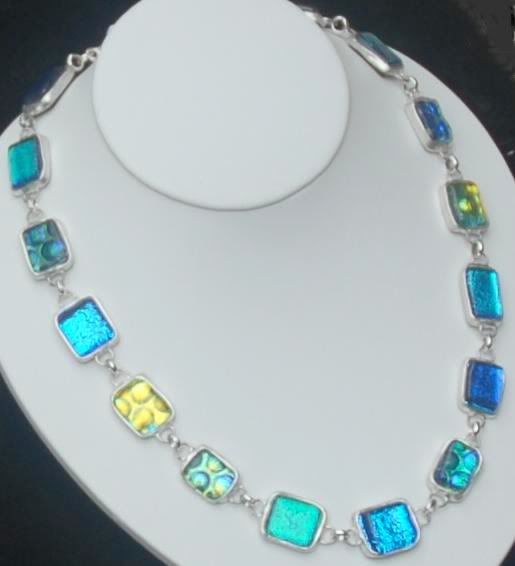
What is Dichroic Glass?


I am often asked "Do you use any paint on your pieces?". The answer is "no, although I would like to try that technique as well. Many of my pieces are made with dichroic glass, a type of glass that has grown in popularity dramatically." Here is a brief overview of what dichroic glass is and how it is made....

The word "dichroic" is derived from two Greek roots, "di" for two and "chroma" for color. So "dichroic" literally means "two-colored", especially when viewed from different angles or from transmitted to reflected light. This bi-colored effect is produced by a process called "thin film physics". Thin-film physics also explains rainbows in soap bubbles, the swirling colors in a thin layer of oil floating on water, and the vibrant iridescent reflections on a dragonfly's wings. To make dichroic glass, metallic oxides (such as titanium, silicon, and magnesium) are heated in a vacuum chamber to very high temperatures, using a high-voltage electron beam, until they are vaporized and deposited onto the surface of glass. The thickness of the oxide on the glass is determined by time and temperature.

Dichroic glass is a high-tech spin-off of the space industry. It was developed for the laser industry but it has become one of the most popular materials used by glass artists today. The brilliance of dichroic glass in natural light or sunlight is truly amazing. Pictures just do not do justice to the depth and play of color. There are many challenges involved in using dichroic glass to make art glass jewelry, not to mention cost. Once a raw sheet of dichroic glass is fused, its characteristics will change yet again with the new colors shifting towards the blue end of the spectrum. That is why I am often waiting impatiently for my kiln to cool properly so that I may see how my pieces turned out. It is all too tempting to open the kiln door too early to take a peak!!

Monday, April 16, 2007

April showers bring May flowers...


I just adore working with Italian Millefiori. The end result can be so fresh and feminine...not to mention that it is just perfect for spring.

Did you ever wonder about the history of Millefiori? Well here is what I found on Wikipedia....

Millefiori is a glasswork technique which produces distinctive decorative patterns on glassware.
The term millefiori is a combination of the Italian words "mille" (thousand) and "fiori" (flowers). A. Pellatt (in his book "Curiosities of Glass Making") was the first to use the term "millefiori", which did not appear in the Oxford Dictionary until 1849. The beads were called mosaic beads before that time. While the use of this technique long precedes the term millefiori, it is now frequently associated with Venetian glassware.

More recently, the millefiori technique has been applied to polymer clays and other materials. Because polymer clay is quite pliable and does not need to be heated and reheated in order to fuse it, it is much easier to produce millefiori patterns than with glass.

History of Millefiori

The making of Millefiori beads involves two glass making techniques. Until the 15th century, Murano glassmakers were only producing drawn Rosetta beads made from mould-made Rosetta canes. Rosetta beads are made by the layering of a variable number of layers of glass of various colors in a mould, and by pulling the soft glass from both ends until the cane has reached the desired thickness. It is then cut into short segments for further processing. The murrine used for decorative purposes were manufactured by applying the same technique, and sold to the lamp workers who made Millefiori beads by weight.

Creating Millefiori

The millefiori technique involves the production of glass canes or rods, known as murrine, with multicolored patterns which are viewable only from the cut ends of the cane. Millefiori beads are made of plain wound glass bead cores. Thin slices of cut cane (murrine) are being pressed into the bead surface, forming mosaic-like patterns, while the glass is still hot. Millefiori beads can be decorated sparingly with a small number of murrine or they can be covered entirely, either by the same style of murrine, or by a combination of two or more styles, applied to form a flush, smooth surface, or left protruding from the bead. The manufacture of mosaic beads can be traced back to Ancient Rome, Phoenician and Alexandrine times. Although the Millefiori technique was developed in Murano, Italy in the 15th century, the heyday of Millefiori bead manufacture ranged from the late 1800s to the early 1900s.

The Millefiori technique is a labour intensive process. Each Millefiori item is individually and painstakingly handmade.

Wednesday, April 11, 2007

Not all glass is created equally...


Examples above are of an art glass pendant, a dichroic pendant, and a millefiore pendant.


Glass fusing has become quite popular. But as a buyer of glass jewelry it is imperative that you buy your glass pieces from an experienced glass artist. Improperly fused glass can crack and break apart on you for no apparent reason. It is important to know how to combine the glass properly since you cannot mix different co-efficient glasses. I work with various types of glasses that have co-efficients of 90, 96, and 104. In addition, it is important that the glass is properly annealed for strength and durability. Annealing is the process by which the glass cools and contracts. It must be done at a certain speed and rate of temperature. Often I will set my kiln to hold certain temperatures for periods of time to ensure the proper annealing. I have also heard many stories about pieces being improperly adhered to bails. I only use a special 2 part epoxy for glass and metal which is carefully cured. I also score up the surfaces so that they adhere better. Curing takes time and it must be done properly. So, the moral is...don't be fooled by cheap imitations...they aren't worth it in the long run.

Friday, March 16, 2007

Fused Glass Cabochons & Tunisian Crochet


I have an incredibly talented (and sweet) customer who has uses my fused glass links in her Tunisian crocheted ponchos. In fact, her ponchos (with my glass) are currently being featured in the March/April issue of Belle Armoire magazine!! Visit www.goshyarnit.com to learn more about Jennifer's amazing Tunisian crochet.

Tunisian crochet is an old artform that offers both experienced and beginning knitters and crocheters new creativity. Tunisian crochet, also known as afghan crochet, incorporates elements of both knitting and crochet, yet is easier to achieve (and easier on the hands) thanks to the extra-large crochet hook used.

Thursday, March 15, 2007

What is Precious Metal Clay (PMC)?


Precious Metal Clay is an incredible material invented by the Japanese. The principal ingredient in PMC is microscopic particles of silver only 20 microns in diameter. As a point of reference, it would take as many as 25 of these particles to make up a single grain of table salt. The rest of the material consists of water & an organic binder. The clay can be molded & shaped into many different designs. Then it is fired in a kiln where both the water & binder burn away & the metal particles fuse to form solid Silver 99.9% pure (for comparison, Sterling is only 92.5% pure). I often use a variety of different types of fused glass (including Dichroic and Murano glasses) within my designs to make spectacular & unique jewelry.

Wednesday, March 14, 2007

Blue Glass....

There is something about it that draws me in every time. No matter how much I try to diversify, I am always drawn back to blue, especially cobalt.

Here are a couple of my new additions...


Cobalt Blue Glass definition from the Glass Encyclopedia:

Cobalt blue glass is normally a deep rich blue. It is made by incorporating cobalt oxide in the molten glass mixture. Most blue glass is given its color either from cobalt oxide or from copper oxide added to the molten glass. Copper is a more delicate colorant than cobalt. It only requires a small amount of cobalt oxide to produce a deep rich blue.

Cobalt is a metal, found in copper and nickel ores in many countries, but mined chiefly in Africa, USSR, Australia, Canada and smaller amounts in other countries. It was discovered by a Swedish chemist, Georg Brandt, in 1742; although the coloring properties of the ore has been known since very ancient times. There was even one piece of cobalt blue glass in Tut-Ankh-Amen's tomb in Egypt.

Before the 1920s the world's production of cobalt was primarily used as a glass and ceramic colorant. Since then it has been used increasingly in metal alloys, and over 80% of today's production of cobalt is used as a metal, - it is, for example, a component of the best magnets. Surprisingly it also makes up 4.3% of vitamin B12.

Small amounts of cobalt (around 1 ounce per ton of glass) are used to neutralize the yellow tint of iron in glass such as window glass. To produce a blue colour in glass, you only need to add five ounces to a ton of glass. Deeper blues are obtained by adding up to ten pounds of cobalt oxide to a ton of glass. This deep blue glass can then be ground up into a powder called "SMALT" which is used as a coloring agent for enamel, for glazes on pottery, and for making more blue glass.

Saturday, March 10, 2007

EGA Featured Member: Glass House Jewelry

February 25th, 2007 by Glass House Jewelry

Hope Marxe is a fused glass artist from New York. Visit her Etsy store at http://glasshousejewelry.etsy.com

When did you first become interested in glass?

I have always loved glass ever since I was young. The way is shimmers and catches the light. I have always had a love of the water as well. They have similar reflective properties. One of my favorite things to do as a kid was to collect sea glass. I could walk on the beach for hours at a time. Now, it is something that my daughter and I love to do together.


What do you like best about what you do?


There are no real mistakes in glass. Like working with oil paints, each “mistake” can merely be a new direction. Ask any glass artist, fusing is completely addictive! I constantly find myself waiting anxiously by the kiln for things to cool so that I can see how they turned out!

Is there a pattern in the way you select materials? In the way you use color, texture or light?

Not really, I try not to pigeon hole myself into one particular style or technique. I am always experimenting. Though it is hard not to let your own personal taste in colors and style influence you.

What inspires you? How are your inspirations expressed in your work?

Nature (particularly the ocean) definitely inspires me. However, my biggest inspiration is our daughter. She is a ray of sunshine in my life and she has taught me the meaning of pure joy. It is just fabulous viewing the world through the eyes of a toddler … truly refreshing! The funniest thing is that she actually critiques all of my pieces. She has a pretty good eye and hasn’t steered me wrong yet!

How much time is spent creating your pieces?

It is hard to balance being a full time mom and working. So, most of my work is done while she is napping or at night.
Needless to say, I don’t get much sleep! Thank goodness we recently moved and I have my own brand new studio…yay!

What are your techniques and style and how do these relate to the medium?

My style is definitely fluid and I am always experimenting with new techniques.

What do you find most challenging about your work in the glass arts?

With so many talented glass artists out there, I find I have to work twice as hard to keep my work original and unique. It is a challenge that I truly enjoy. I am constantly experimenting and trying new techniques without knowing for sure what the outcome might be. Some of my favorite designs I just “stumbled” upon after trying many different things.

The other big challenge I have encountered is properly photographing glass jewelry. It is truly difficult to capture properly. I find that I am constantly retaking my photos over and over…never being truly satisfied with them…sigh…

How did you find Etsy? What do you like most about it?

On Google. I was looking for supplies and several Etsy stores came up. So, I got curious, checked it out, and the rest is history. I love that Etsy is almost exclusively hand made and I have found it to be a wonderfully warm community of people.