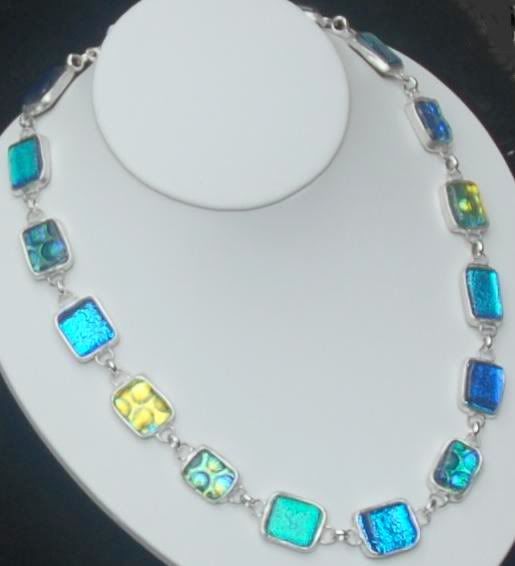
Well, I finally did it... I have my own website (besides the various sites I sell on: Etsy.com, Lovli, Mintd, etc). www.glasshousejewelry.com has been born! It is still very much a work in progress. But now at least I have a central location where I can organize my business.
Feel free to contact me with any questions, special orders/requests, and of course, wholesale orders.
Thursday, June 28, 2007


Friday, May 11, 2007
Friday, April 27, 2007
What is Dichroic Glass?

I am often asked "Do you use any paint on your pieces?". The answer is "no, although I would like to try that technique as well. Many of my pieces are made with dichroic glass, a type of glass that has grown in popularity dramatically." Here is a brief overview of what dichroic glass is and how it is made....
The word "dichroic" is derived from two Greek roots, "di" for two and "chroma" for color. So "dichroic" literally means "two-colored", especially when viewed from different angles or from transmitted to reflected light. This bi-colored effect is produced by a process called "thin film physics". Thin-film physics also explains rainbows in soap bubbles, the swirling colors in a thin layer of oil floating on water, and the vibrant iridescent reflections on a dragonfly's wings. To make dichroic glass, metallic oxides (such as titanium, silicon, and magnesium) are heated in a vacuum chamber to very high temperatures, using a high-voltage electron beam, until they are vaporized and deposited onto the surface of glass. The thickness of the oxide on the glass is determined by time and temperature.
Dichroic glass is a high-tech spin-off of the space industry. It was developed for the laser industry but it has become one of the most popular materials used by glass artists today. The brilliance of dichroic glass in natural light or sunlight is truly amazing. Pictures just do not do justice to the depth and play of color. There are many challenges involved in using dichroic glass to make art glass jewelry, not to mention cost. Once a raw sheet of dichroic glass is fused, its characteristics will change yet again with the new colors shifting towards the blue end of the spectrum. That is why I am often waiting impatiently for my kiln to cool properly so that I may see how my pieces turned out. It is all too tempting to open the kiln door too early to take a peak!!
Monday, April 16, 2007
April showers bring May flowers...

I just adore working with Italian Millefiori. The end result can be so fresh and feminine...not to mention that it is just perfect for spring.
Did you ever wonder about the history of Millefiori? Well here is what I found on Wikipedia....
Millefiori is a glasswork technique which produces distinctive decorative patterns on glassware.
The term millefiori is a combination of the Italian words "mille" (thousand) and "fiori" (flowers). A. Pellatt (in his book "Curiosities of Glass Making") was the first to use the term "millefiori", which did not appear in the Oxford Dictionary until 1849. The beads were called mosaic beads before that time. While the use of this technique long precedes the term millefiori, it is now frequently associated with Venetian glassware.
More recently, the millefiori technique has been applied to polymer clays and other materials. Because polymer clay is quite pliable and does not need to be heated and reheated in order to fuse it, it is much easier to produce millefiori patterns than with glass.
History of Millefiori
The making of Millefiori beads involves two glass making techniques. Until the 15th century, Murano glassmakers were only producing drawn Rosetta beads made from mould-made Rosetta canes. Rosetta beads are made by the layering of a variable number of layers of glass of various colors in a mould, and by pulling the soft glass from both ends until the cane has reached the desired thickness. It is then cut into short segments for further processing. The murrine used for decorative purposes were manufactured by applying the same technique, and sold to the lamp workers who made Millefiori beads by weight.
Creating Millefiori
The millefiori technique involves the production of glass canes or rods, known as murrine, with multicolored patterns which are viewable only from the cut ends of the cane. Millefiori beads are made of plain wound glass bead cores. Thin slices of cut cane (murrine) are being pressed into the bead surface, forming mosaic-like patterns, while the glass is still hot. Millefiori beads can be decorated sparingly with a small number of murrine or they can be covered entirely, either by the same style of murrine, or by a combination of two or more styles, applied to form a flush, smooth surface, or left protruding from the bead. The manufacture of mosaic beads can be traced back to Ancient Rome, Phoenician and Alexandrine times. Although the Millefiori technique was developed in Murano, Italy in the 15th century, the heyday of Millefiori bead manufacture ranged from the late 1800s to the early 1900s.
The Millefiori technique is a labour intensive process. Each Millefiori item is individually and painstakingly handmade.
Wednesday, April 11, 2007
Not all glass is created equally...


Examples above are of an art glass pendant, a dichroic pendant, and a millefiore pendant.
Glass fusing has become quite popular. But as a buyer of glass jewelry it is imperative that you buy your glass pieces from an experienced glass artist. Improperly fused glass can crack and break apart on you for no apparent reason. It is important to know how to combine the glass properly since you cannot mix different co-efficient glasses. I work with various types of glasses that have co-efficients of 90, 96, and 104. In addition, it is important that the glass is properly annealed for strength and durability. Annealing is the process by which the glass cools and contracts. It must be done at a certain speed and rate of temperature. Often I will set my kiln to hold certain temperatures for periods of time to ensure the proper annealing. I have also heard many stories about pieces being improperly adhered to bails. I only use a special 2 part epoxy for glass and metal which is carefully cured. I also score up the surfaces so that they adhere better. Curing takes time and it must be done properly. So, the moral is...don't be fooled by cheap imitations...they aren't worth it in the long run.
Friday, March 16, 2007
Fused Glass Cabochons & Tunisian Crochet


I have an incredibly talented (and sweet) customer who has uses my fused glass links in her Tunisian crocheted ponchos. In fact, her ponchos (with my glass) are currently being featured in the March/April issue of Belle Armoire magazine!! Visit www.goshyarnit.com to learn more about Jennifer's amazing Tunisian crochet.
Tunisian crochet is an old artform that offers both experienced and beginning knitters and crocheters new creativity. Tunisian crochet, also known as afghan crochet, incorporates elements of both knitting and crochet, yet is easier to achieve (and easier on the hands) thanks to the extra-large crochet hook used.
Thursday, March 15, 2007
What is Precious Metal Clay (PMC)?
1.JPG)
Precious Metal Clay is an incredible material invented by the Japanese. The principal ingredient in PMC is microscopic particles of silver only 20 microns in diameter. As a point of reference, it would take as many as 25 of these particles to make up a single grain of table salt. The rest of the material consists of water & an organic binder. The clay can be molded & shaped into many different designs. Then it is fired in a kiln where both the water & binder burn away & the metal particles fuse to form solid Silver 99.9% pure (for comparison, Sterling is only 92.5% pure). I often use a variety of different types of fused glass (including Dichroic and Murano glasses) within my designs to make spectacular & unique jewelry.
Subscribe to:
Posts (Atom)